Are you planning your Atlantic crossing?
It’s time to give your yacht the ultimate upgrade: the New Generation Parasailor with the patented hybrid wing. This allows you to sail safely and comfortably downwind and save money and space on board.
Because the Parasailor is an extremely versatile sail that can be used in a very wide angle range from 70° to 180°. So you can enjoy the advantages of a spinnaker and a gennaker at the same time with just one sail.
On approximately 2,700 nautical miles across the Atlantic, you can generally expect the north-easterly trade winds. That means you will be sailing with the wind from astern most of the time. Everyone should therefore ask themselves which downwind sail is best suited to their boat, their sailing skills and safety requirements, their crew and their individual sailing style.
Fitting out Genoa, use a butterfly, gennaker or spinnaker? There are many options, but Parasailor with its hybrid wing will get your boat up to top speed effortlessly and is easy to handle. Parasailor has also been developed to be stable and keep the boat calm. You can even sail your boat on autopilot.
A survey conducted by the English sailing magazine “Yachting World” among participants in the World Cruising Clubs ARC revealed that Parasailor is one of the most important pieces of equipment for an Atlantic crossing. In retrospect, the majority of sailors would have liked to have it on board.
What makes Parasailor so special for your Atlantic crossing?
Less rolling: Due to the righting moment of the Parasailor hybrid wing and the laminar flow* in the sail, caused by the opening in the sail itself, the sail and therefore the boat stabilize almost automatically. This leads to a considerable reduction in rolling and rocking movements. Anyone who has ever made an Atlantic crossing knows how important reduced ship movements are for a relaxed stay on board.
CUSTOMER VIDEO: We would like to thank our customer for the vivid video and for making it available.
Two sails in one:: The Parasailor replaces two sails in one. Depending on the type of boat, it can be used from 70° to 180° (apparent wind incidence angle) and thus covers the range of use of a spinnaker and a gennaker. This saves much-needed space on board, reduces the number of sail wardrobe changes and is easy on the wallet. Another benefit for a relaxed Atlantic crossing. Here you can find a vivid presentation to this topic.
Can be sailed with or without a spinnaker pole: The Parasailor offers you various sailing options. You can use it with a spinnaker pole, similar to a conventional spinnaker. Alternatively, you can also sail the Parasailor without a spinnaker pole by using two additional tack lines that run across the bow. Another option is to use a tacker, a sleeve that sits on the furled headsail. Here you tack the Parasailor almost like a gennaker. This flexibility makes it possible to adapt the Parasailor to the prevailing conditions and get the most out of your Atlantic crossing.
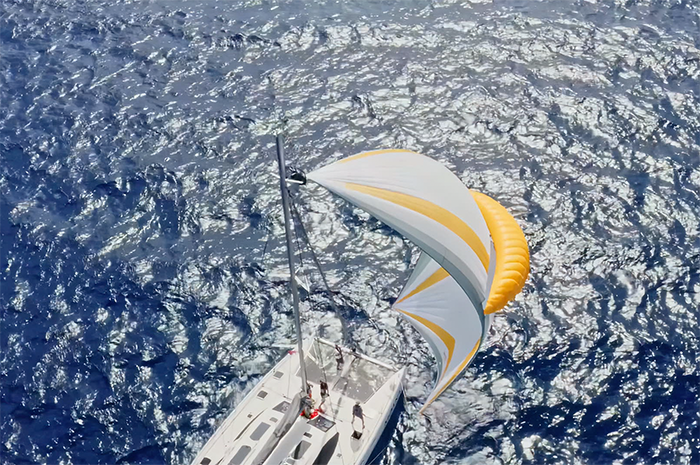
Can be sailed with or without a spinnaker pole
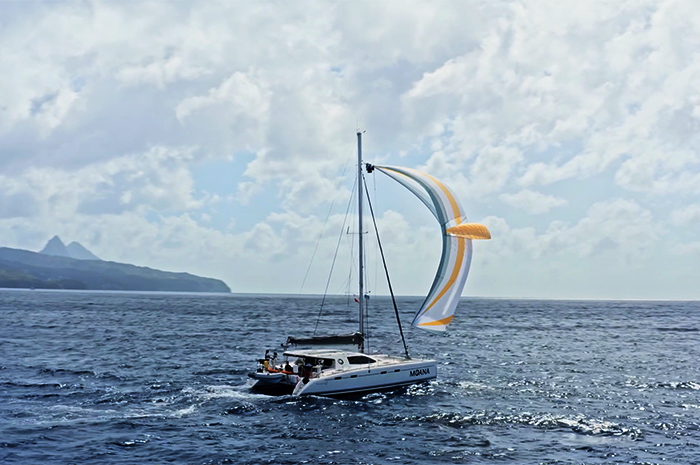
Perfect for autopilot
Perfect for autopilot: The Parasailor has excellent self-trimming properties that cope very well with the steering movements of the autopilot. Due to its self-supporting stability and low tendency to roll, the Parasailor requires only minimal corrections from the autopilot. The ideal combination for long-distance sailing across the Atlantic. The buoyancy of the Parasailor hybrid wing means that the bow of the boat is not pushed into the water. Therefore the rudder is not lifted out of the water. As a result, the rudder remains fully effective, running out of the rudder is virtually impossible and the autopilot can do its job to the full.
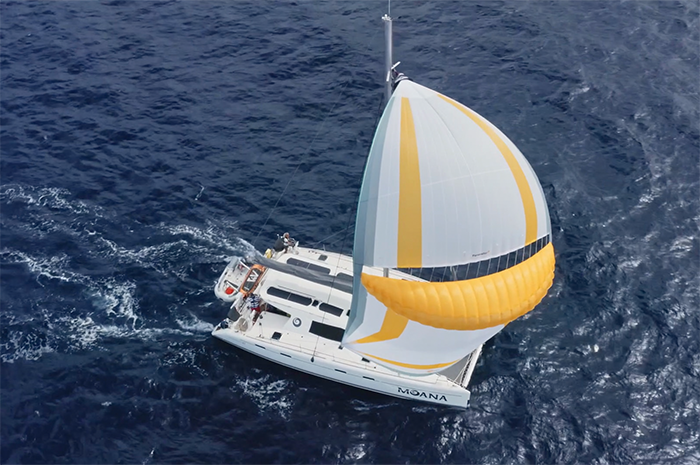
A must-have for every catamaran: For purely design reasons, the catamaran's predestined courses are downwind courses. This contrasts with the catamaran's mostly backstayless rig.
So the question arises of which is the ideal sailing wardrobe for downwind courses, because tacking downwind is uncomfortable, especially on long journeys. A wide opening of the mainsail is prevented by the usually strongly swept spreaders. There is also a risk of a patent jibe.
Parasailor offers the ideal solution here. The good-natured, colorful cloth can be ideally sheeted over the widely spaced bow tips of the catamaran. The buoyancy of the hybrid wing noticeably relieves the bow tips. The stable position of Parasailor ensures maximum comfort and safety, which no other downwind sail offers. Coupled with the wide range of use that Parasailor offers, it is the ideal sail for every multihull.
What is the hybrid wing and why is it so innovative?
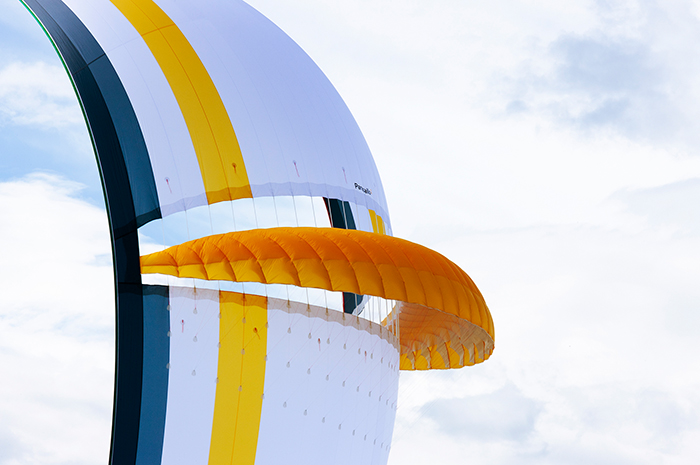
The hybrid wing combines ram pressure and single wing elements in a unique way. This enables significantly higher performance and stability while sailing. The hybrid wing has a special wing geometry that generates noticeable lift through a larger angle of attack and increased wing camber, while at the same time lifting the bow of the ship.
In comparison, when sailing with a gennaker or spinnaker, the bow is pushed into the water and loses speed as a result. In contrast, the Parasailor takes the pressure off the bow, the boat performs better and it is virtually impossible to run out of the rudder.
We have also optimized the projected wing area to simplify setting and recovering the Parasailor and to increase safety on board. The integrated mesh material and active valve flaps ensure efficient airflow and fast wing deployment. This unique design offers sailors more performance and stability even at very low wind speeds. This combination of performance and stability makes Parasailor the superior choice for demanding cruises such as Atlantic crossings and long distance sailing. For a detailed explanation of the wing design, click here.
Why does the Parasailor not have the laminar flow of the spinnaker?
In this context, “laminar flow” refers to the way the wind flows around the sail. A conventional spinnaker, especially a symmetrical spinnaker, is a closed system where the wind enters the sail, swirls and then “spills” out over one side. This leads to turbulence, which can cause the spinnaker to rock back and forth and not remain stable in one position. This is extremely uncomfortable on a trip lasting several weeks, such as an Atlantic crossing.
Parasailor is designed to catch/channel the wind current and keep it free of turbulence. This is achieved through an opening in the sail, which is required for the inflow of the hybrid wing. As a result, the air flows through the sail gently and without turbulent eddies. The result is a more stable position of the sail and less tendency to rock back and forth, even at low wind speeds of 2-3 knots.
In other words, the laminar flow achieved by the design of the Parasailor sail, in addition to the lift of the hybrid wing, contributes to a smoother and more stable sail, even in changing wind conditions. The comfort and safety of sailing are noticeably improved.
What our customers say
Whether North Atlantic or Transatlantic
Many of you who are planning an Atlantic crossing for the first time are asking yourselves these questions
Oh yes…, there was something else…
The best way tho get back after the Atlantic crossing:
If you want to return home quickly after your sailing trip, a charter flight is a convenient option. You can simply book a flight from your destination in the Caribbean to your home country. Most major airports in the Caribbean have international flight connections. You can have the boat transferred or you can take a charter yacht.
If you want to sail back to Europe from the Caribbean yourself, the ideal time to start is May. At this time of year, most of the strong spring storms have already passed and the hurricane season is not yet upon us. So why not include a few weeks of Caribbean vacation in your plan?
Another interesting option is to load your sailing boat onto a cargo ship, which will transport it back for you. This requires special arrangements and logistics. This gives you the option of travelling home quickly and comfortably by plane.